Force Diagrams Review

When you are making a force diagram, there are two things to think about:The five force types all have different requirements for what their size and direction are:When you are making a force diagram, it takes some finesse to make all the arrows the appropriate length. I usually draw an angled force first, since I can then draw its components and they give me a sense of the scale along both directions.
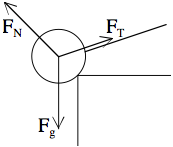
Example: a ball is sitting on the edge of a table, held from falling by a string.
Here, I drew the normal force first. Then, I carefully drew the tension force to be just as wide, just as big horizontally, as the normal force I had just drawn. Finally, I added together the heights of those two forces to figure out how long the gravity force should be.
For each of the diagrams below, draw the forces acting on the object. The forces on each object are balanced. Take care to make this evident in the size of your force arrows.
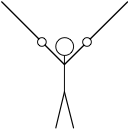
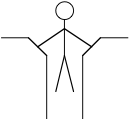
A gymnast hangs from two rings.
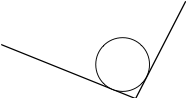
A ball rests in a corner.
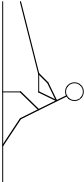
A climber "rapels" down a cliff by suporting himself with a rope and walking down.
The same climber lifts himself out of a "chimney" by pressing with both hands.

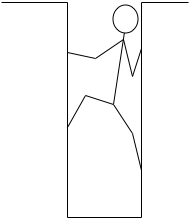
  1. In a sufficiently narrow hallway, you can climb up the walls just by pressing your hands and feet against the two walls and "walking" up them.

    a) What force holds you up?


    b) Draw a force diagram for this situation. You can treat the hands and feet on one side as a single normal force rather than two, since both feel a force from the same surface.


    c) Assume that μ = .9, = -72 N, and the weight is held evenly by both sides. Solve for all the other force vectors.


    d) What is easier, walking up a wall like this or doing push-ups?


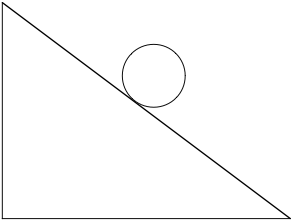
  2. A ball with a mass of 10 kg is placed on a ramp. The ball rolls down the ramp with = (4.8 - 3.6) m/s².

    a) What is the net force vector on the ball? (F = ma)


    b) The only forces acting on the ball are gravity, and the normal force. Draw in these two force, and find the vector form of the normal force. Does the normal force point the direction you expected?